








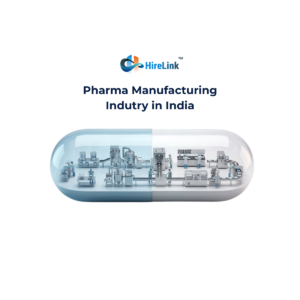

Pharma Manufacturing Industry in India: Growth & Talent Demand
Introduction India’s pharma industry is one of the strongest pillars of global healthcare. Known as the “Pharmacy of the World,” India supplies affordable medicines across 200+ countries. But behind this scale is not just infrastructure—it is talent, precision, and compliance-driven operations. Today, pharma manufacturing is not just about production. It is about quality, regulatory excellence, and having the right people in the right roles—something we at HireLink™ see closely while working with the industry. Industry Overview India stands strong in the global pharma space: 🌍 3rd largest by volume globally💊 Supplies ~20% of global generics📦 Exports worth $30+ billion annually🌐 Serves 200+ countries With continuous expansion in manufacturing units and exports, the industry is growing rapidly. What is Driving the Growth? 📈 Rising global demand for affordable medicines🏭 Expansion of manufacturing plants🧪 Strict regulatory standards (USFDA, WHO, cGMP)🇮🇳 Government support (PLI schemes) Who is Behind this Growth? While infrastructure and policies drive expansion, the real backbone of pharma manufacturing is qualified and skilled professionals. Every stage—from raw material handling to final product release—requires trained talent with strong cGMP understanding, technical expertise, and attention to detail. 👉 Without the right workforce, even the most advanced manufacturing facility cannot operate efficiently—this is where HireLink™ focuses on enabling the right talent connections. What Qualifications are Needed? Pharma manufacturing brings together professionals from diverse backgrounds, each playing a critical role in the ecosystem. 🧪 Life Sciences (B.Pharm, M.Pharm, B.Sc) Drives QA/QC, Regulatory, and ensures cGMP compliance ⚙️ Engineering (Mechanical, Electrical, Instrumentation) Manages HVAC, utilities, maintenance, and plant efficiency 🏭 Production (Diploma, B.Pharm, B.Sc) Handles manufacturing processes and batch operations 📦 Supply Chain & Management (BBA, MBA, B.Com) Ensures smooth procurement, inventory, and distribution Each segment plays a vital role in maintaining quality, compliance, and production efficiency—requiring a strong approach to match skills with roles. What Roles Do They Play? Each talent segment contributes through specific roles in pharma manufacturing: 🧪 Life Sciences Professionals QA Executive, QC Analyst, Regulatory Affairs Associate, Validation Executive ⚙️ Engineering Professionals HVAC Engineer, Maintenance Engineer, Utility Engineer, Automation Engineer 🏭 Production Teams Production Executive, Production Supervisor, Shift Incharge, Plant Operator 📦 Supply Chain & Management Procurement Executive, Supply Chain Analyst, Warehouse Manager, Logistics Coordinator Identifying the right role alignment is critical—and this is where structured hiring frameworks play a key role. Challenges Companies Face Pharma companies today face multiple operational challenges: These challenges directly impact critical business functions such as production timelines, quality standards, regulatory compliance, sales growth, and overall operational efficiency. While companies are actively addressing these through improved systems and processes, new strategies, innovation, and technology adoption, one major challenge still remains—finding the right people for the right roles with the right experience. This is where a domain expert recruitment partner like HireLink™ ensures access to the right talent—supporting smoother operations, faster hiring, and sustainable business growth. Conclusion Pharma manufacturing in India is evolving rapidly—but success ultimately depends on having the right talent in place at the right time. At HireLink™, we simplify this by delivering: Our focus is to help organizations build strong, reliable teams while making the hiring journey seamless for candidates. Hire smarter. Hire faster. HireLink™. Explore more opportunities on HireLink: www.hirelinkpro.com oin our WhatsApp Channel for early job updates: https://whatsapp.com/channel/0029VbBlPno5EjxyNuQZ360J



















Review Text
Testimonial #1 Designation